Is the Scroll of Taiwu English Translation Good? (1.0 Localization)
A current assessment of The Scroll of Taiwu 1.0 English localization: what the official translation covers, where isolated gaps may remain, and how to cross-reference older Chinese terminology.
Is the English translation good? (short answer)
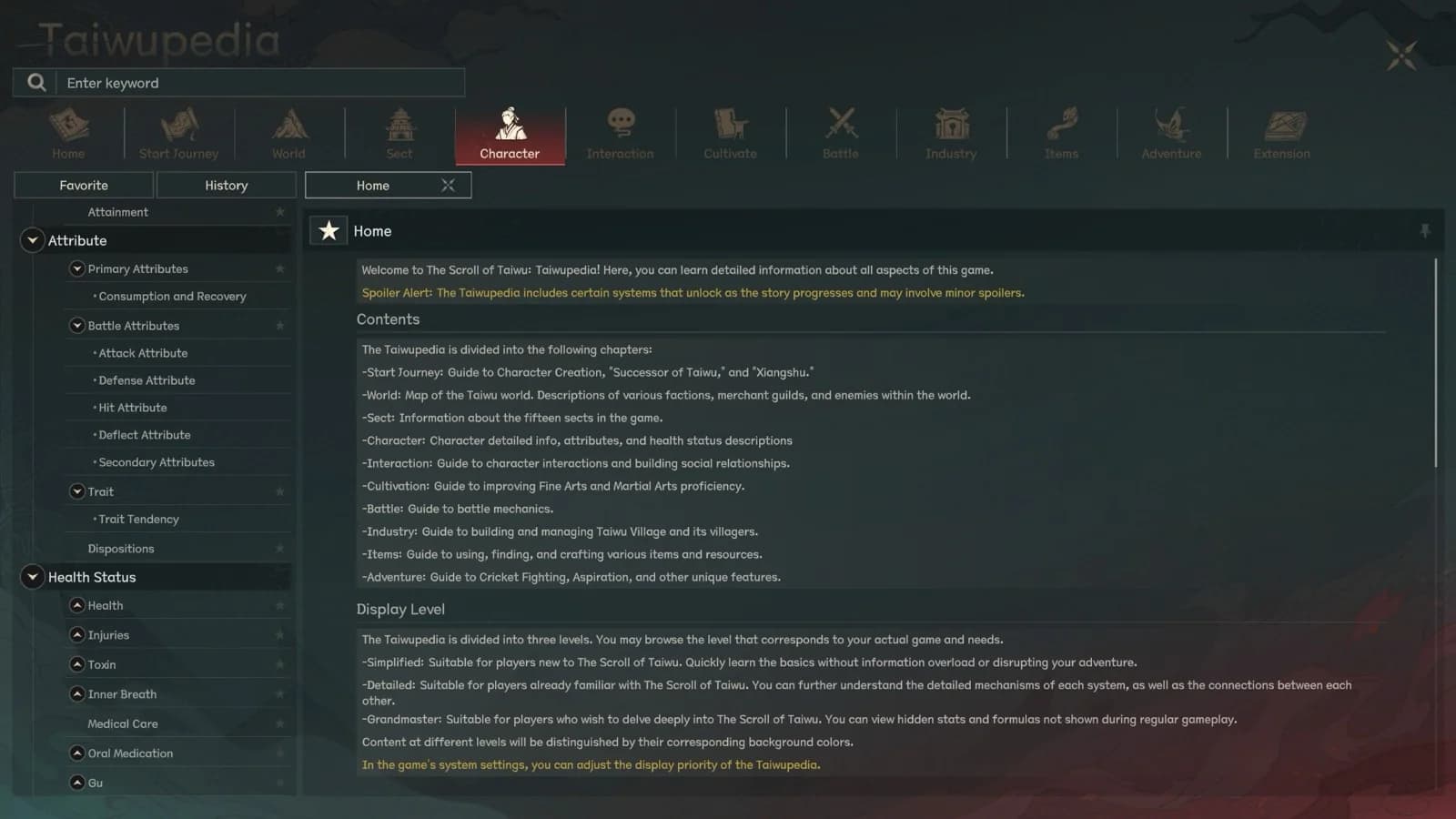
Yes — the 1.0 release ships the first official English localization, and the core game is genuinely playable in English rather than depending on the old fan patch. Main UI, tutorials, attributes, factions, martial-art categories, and Taiwupedia are available in English.
The honest caveat is coverage and precision, not basic playability. Isolated event, DLC, Workshop, or deep-system strings can still be incomplete. After patch #260722, players reported blank English dialogue in the reworked Wicked Beggars encounter and a language-sensitive tournament follow-up error. Temporarily switching to Simplified Chinese can expose the missing event text, but that is a workaround rather than a fix. Continued English localization remains part of the official post-launch plan.
- Core base-game UI, tutorials, factions, martial arts, and Taiwupedia are available in English in 1.0.
- It is an official localization, not the community fan patch.
- Isolated DLC, Workshop, event, or deep-system strings can still require cross-checking.
- For a blank event after #260722, back up the save and try Simplified Chinese only long enough to pass that event, then switch back.
- Continued English localization is part of the official post-launch roadmap.
What is translated and where gaps can remain
For practical purposes, treat the core game as English and treat add-on, newly reworked, or edge content as the place you may still meet Chinese or blank strings. This split is why most players see a usable English game while a few report isolated gaps — it depends on which content they touched.
If you do hit Chinese text, the terminology reference further down this page lets you match it to the right system, and a screenshot to the developers helps them prioritize the next localization pass.
- Core English coverage: main menu, settings, character creation, factions, attributes, combat UI, Taiwupedia.
- Mostly English: quests, events, item and martial-art descriptions.
- May still need checking: isolated DLC, Workshop, newly reworked event, rare-event, or deep-system strings.
- Known current signal: players reported blank English dialogue in the #260722 Wicked Beggars rework.
- Current workaround signal: affected event text renders in Simplified Chinese; one tournament follow-up block also cleared after the language switch.
- How to switch to English: globe icon top-left of the main menu, or Settings → first tab → language.
The core terms you will see most
The Scroll of Taiwu carries years of Chinese community knowledge, and most of the best strategy writing is still in Chinese. This guide maps the system vocabulary so an English player can read those guides and match them to in-game text.
The terms worth learning first cover faction names, martial art categories, attributes, combat resources, injury states, village systems, and special cultural terms such as Taiwu, Xiangshu, Sword Tomb, and cricket fighting.
- Attributes: 根骨, 悟性, 定力, 福缘, 膂力, 灵敏.
- Martial arts: 武功, 内功, 外功, 轻功, 绝技.
- Combat: 真气, 架势, 提气, 破体, 破气, 护体, 御气.
- Injuries: 伤势, 内伤, 外伤, 毒素, 治疗.
- Campaign systems: 太吾村, 传承, 奇遇, 促织.
How to read a Chinese guide as an English player
Most Chinese strategy posts follow the same pattern: pick a faction, learn one internal art plus a weapon or external art, manage injuries, and stabilize the village. Once you recognize the recurring terms, the structure of those guides becomes easy to follow.
Start from the glossary as your single reference, then read faction and martial-art pages with the Chinese term in view. Matching the Chinese characters against the in-game text is the fastest way to confirm you are looking at the same system.
- Keep the glossary open while reading Chinese guides.
- Match the Chinese term against the in-game UI text.
- Use faction and martial-art pages to connect terms to builds.
- Note the attribute and combat-resource terms early — they appear constantly.
- When a term is unfamiliar, search this site by the Chinese characters.
Why Chinese terms stay visible
Chinese terms stay visible because they make the site auditable. If a reader knows the Chinese term, they can see what concept the English explanation is referring to. If official English uses a surprising phrase, the Chinese term prevents confusion.
This matters especially for a game with years of Chinese community knowledge. Searchers may arrive with pinyin, literal translations, fan translations, or official terms. A good English guide needs to bridge those vocabularies.
- Chinese terms help old Chinese guides map to new English searches.
- They make user corrections easier and less ambiguous.
- They reduce the risk of silently replacing one concept with another.
- They help launch-day updates move quickly.
Watch out for false friends
Some English words map cleanly to one Chinese system, but a few are easy to confuse because similar English wording describes different mechanics. These are the cases where keeping the Chinese term in view saves the most trouble, especially for combat resources and injury states.
When two terms feel interchangeable in English, fall back to the Chinese characters and the category. The character is the unambiguous identity of the system; the English is just the readable label on top of it.
- Internal vs external: 内功 (internal art) is your engine, while 内伤 (internal injury) is damage — different systems that both translate with the word internal.
- Qi terms: 真气, 提气, 御气, and 护气 all touch combat resource and defense but are not the same lever.
- Body terms: 根骨 (Root Bone attribute) and 护体 (body protection in combat) both sound like toughness but live in different menus.
- When unsure, trust the Chinese characters and the system category over the English phrasing.
How readers can help
The most useful correction includes the page URL, the Chinese term or current English wording, the official English wording, and a screenshot or source note. A short, specific correction is more useful than a broad claim that a page feels wrong.
Terminology fixes take priority over opinion changes, because consistent terms are what let players search, discuss, and follow guides. Once names are settled, attention can shift to balance, route testing, and advanced strategy.
- Send the exact page URL.
- Include the Chinese term if relevant.
- Quote the official English term from the game.
- Attach a screenshot or source note when possible.
Related paths
Sources and verification
First-party patch notes and announcements are treated as the source of truth. Community links are included only to show the player question this guide answers.
FAQ
Why keep the Chinese terms next to the English ones?
Because most existing Taiwu strategy is written in Chinese, and the in-game text uses the same characters. Seeing both lets you match this site to the game and to community guides without ambiguity.
Which terms should I learn first?
Start with the six attributes and the martial-art categories (内功, 外功, 轻功, 绝技). They appear in almost every build discussion and unlock the rest quickly.
Where should corrections go?
Send corrections through the contact page with the page URL, Chinese term, official English term, and source note.
What should I do if an event is blank in English?
Back up the save, switch temporarily to Simplified Chinese from the main-menu language control, pass or inspect the affected event, then switch back to English. Players report this exposes blank #260722-era event text, but it is only a temporary workaround; report the build, event, and screenshot so the localization bug can be fixed.