Attributes Explained
A plain-English explanation of key Taiwu attributes, their Chinese terms, and how beginners should think about stats.
Attributes are build direction, not a scorecard
New players often read attributes as a simple good-or-bad character score. That is not the useful mental model. Attributes tell you which plans are comfortable, which arts are easier to support, and where your character will struggle if you spread too thin.
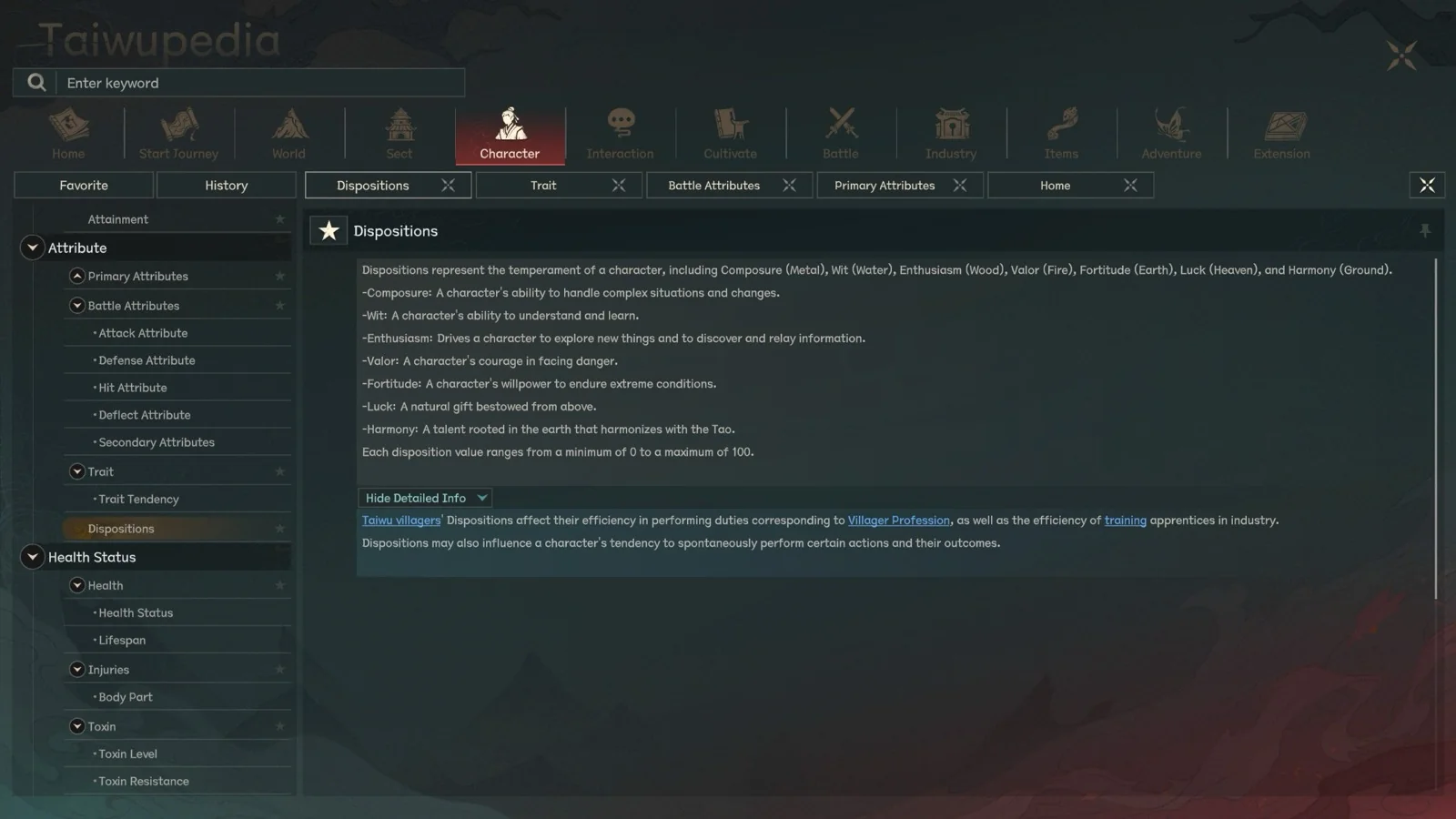
The official English client groups a character under six Primary Attributes, shown below with their Chinese terms so you can match them to the in-game UI and to Chinese community guides without confusion. Luck is a common point of confusion: it is a Disposition, not one of the six Primary Attributes.
- 膂力 / Strength: physical power and explosive, heavy routes.
- 灵敏 / Agility: nimbleness, coordination, and movement comfort.
- 定力 / Willpower: will and judgment under pressure.
- 体质 / Constitution: resilience, endurance, and durability.
- 根骨 / Root Bone: innate quality that shapes long-term potential.
- 悟性 / Comprehension: understanding, learning speed, and technical comfort.
- 福缘 / Luck: a Disposition (Heaven), not a Primary Attribute — found under Character → Dispositions in the 1.0 client.
Match stats to a route
A beginner build becomes much easier when its stats, weapon, faction, and arts all point in the same direction. A heavy blade route wants physical commitment. A sword counter route wants enough perception and resolve to make timing and internal support reliable. A needle or hidden-weapon route asks for more speed and positioning comfort.
If your build feels weak, the problem may not be the faction. It may be that your stats and arts are asking for different characters.
- Shaolin and Yuanshan are friendly to physical and durable routes.
- Wudang likes balanced sword, internal support, and patient control.
- Emei and Valley of Flowers reward utility, recovery, and careful range.
- Jade-Maiden Sect and Veil Scar Sect punish poor agility and positioning decisions.
- Five Immortals and Kongsang often ask for more system knowledge than raw stats.
Do not overreact to one low attribute
A low attribute is not always a dead character. It is a warning label. If you know the weakness, you can choose simpler arts, avoid routes that demand that stat, and use equipment or support systems to reduce the damage.
The danger is building as if the weakness does not exist. A fragile character can work if the route avoids bad trades. A slow character can work if the route controls range differently. A low-comprehension character may still survive if the plan is simple.
- Low durability: avoid routes that trade hits casually.
- Low agility: avoid fragile precision routes until you know spacing.
- Low perception: keep the build simple and avoid technical hybrids.
- Low resolve: value defensive and recovery support earlier.
Use attributes to choose what not to do
The strongest use of attributes is exclusion. Instead of asking what your character can theoretically learn, ask which plans create avoidable friction. A first run gets smoother when you cut options that fight your stat line.
This is why starter builds are helpful: they bundle faction, arts, and stat focus into one readable route. You can still improvise, but you are improvising from a coherent center.
- If you choose a defensive faction, do not immediately chase fragile burst arts.
- If you choose a technical faction, do not ignore perception and utility support.
- If you choose a weapon-first faction, keep gear and relevant stats aligned.
- If you are lost, use the build planner as a coherence check.
Related paths
FAQ
Are these official English attribute names?
Each attribute is shown with its Chinese term so you can confirm it against the in-game UI at a glance.
Can a bad attribute ruin a run?
Usually no. It can make some routes uncomfortable, but a focused build can work around weaknesses.
Should beginners min-max attributes?
No. Beginners should use attributes to avoid incoherent builds, not chase perfect optimization.