Scroll of Taiwu Beginner Guide — What to Do After the Prologue
A plain-English Scroll of Taiwu beginner route for the prologue and the open world after it: village priorities, factions, study, combat, travel, Sword Mounds, and succession.
The mental model
The Scroll of Taiwu is not only a martial arts RPG. It is also a dynasty game, a relationship game, a village game, and a long-form systems sandbox. A first run should not aim to understand everything.
Your goal is simple: keep Taiwu alive, learn one reliable combat route, maintain the village, and let every failure teach you one more subsystem.
The single biggest shift for new players is to stop treating Taiwu like a game you can fully read before acting. You are meant to learn by doing, losing, and adjusting. The players who enjoy their first run the most are the ones who accept partial understanding, protect their character from fatal mistakes, and let the systems reveal themselves one at a time.
- Choose a forgiving faction before choosing a stylish one.
- Build around two or three martial arts instead of collecting everything.
- Treat injuries, relationships, and resources as campaign systems, not side clutter.
- Accept that your first character is a teacher, not a masterpiece.
What the opening actually looks like
When you start, you control one Taiwu heir in a large, reactive world. You will travel between locations, meet other characters, join or oppose factions, learn martial arts from manuals and teachers, fight, get injured, recover, and slowly build up your home village. None of this happens on a strict story rail, which is exactly why it feels overwhelming at first.
The trap is freedom. Because the game rarely tells you what to do next, new players often wander, pick fights they are not ready for, and spread their character thin. The cure is to impose your own small plan: one faction, one combat route, one stable village, and a habit of recovering before pushing forward.
- You explore a reactive world rather than a linear story.
- Martial arts come from manuals, teachers, and faction access.
- Fights, injuries, and recovery form a loop you will repeat constantly.
- Your village grows in the background as your long-term safety net.
What to do after the prologue: the repeatable gameplay loop
When the prologue loosens its grip, the game is not waiting for one hidden main quest. You have entered the campaign loop: strengthen Taiwu, turn the village into a dependable base, earn access to better teaching, and choose when you are ready to push a regional story or Sword Mound. If the journal offers several directions at once, that is normal rather than a sign that you missed a trigger.
A safe first cycle is: return to Taiwu Village and stabilize its work, pick one faction route, obtain permission and manuals for one coherent combat plan, study and break through those arts, recover and restock, then take a nearby encounter or story objective that tests the plan. Come home, repair the weak point, and repeat at a slightly higher level. That loop is the game.
- 1. Village: clear useful ruins, assign adults to work, and build a small reserve of materials and Silver.
- 2. Access: earn Prestige and regional Favor, activate only the way stations you actually need, and work toward Sect Training Permission.
- 3. Study: focus on one weapon route plus a compatible Qi Art, Footwork Art, and defensive or utility answer.
- 4. Practice: read manuals, raise proficiency and attainment, complete breakthroughs, and test the loadout against manageable fights.
- 5. Progress: follow regional stories, relationships, encounters, and faction opportunities that improve that route.
- 6. Challenge: approach Sword Mounds only when the current character can survive the journey and recover from a bad fight.
- 7. Continue: if a Taiwu dies, succession carries the campaign forward; one imperfect heir is not a failed save.
What debates, fine arts, and social play are for
Combat is only one way to make progress. Debate and fine-arts skills support conversations, events, access checks, relationships, teaching, and resource opportunities. You do not need to master every art immediately, but ignoring the social side entirely can make the open world feel much narrower than it is.
Treat non-combat study as a key ring rather than a second combat build. Raise the skills that repeatedly appear in the faction, profession, or story route you are already following. Let a real blocked interaction tell you what to study next instead of trying to max every category in advance.
- Use debate when an encounter or relationship check offers a non-combat route.
- Study the fine art that matches the profession or event chain you are actively pursuing.
- Keep one clear combat plan even while adding social and production skills.
- If a check is too high, leave, improve the relevant skill or relationship, and return later.
Launch-day setup (English 1.0)
If you just installed the English 1.0 / Complete Edition, two things confuse almost everyone in the first ten minutes, so clear them before you start. First, the main menu boots Chinese-first — but after the June 17 day-one patch there is a quick language switcher in the top-left corner of the main menu (a small globe icon). Click it and choose English (the options are 简体中文 / 繁體中文 / English / 한국어). If you prefer the long way, language is also under Settings → first tab → language dropdown.
Second, the version label: the main menu shows 1.0.1 after the day-one patch, while some build strings still read v0.84.75. Either way it is the 1.0 release, not a leftover Early Access build — the preserved old Early Access client lives on a separate "test" beta branch, so you have not installed the wrong version.
The official English localization is live. Some older guides, screenshots, Workshop text, or isolated strings can still use Chinese terminology, so this site keeps the original Chinese term beside important English labels whenever it helps you cross-reference the same mechanic.
- Switch to English: language switcher (globe, top-left of the main menu) → English. (Also under Settings → first tab.)
- Main menu shows 1.0.1 (some build strings read v0.84.75) — both are the 1.0 build, not Early Access.
- The game auto-saves at the end of each in-game month; there is no manual quick-save.
- If an older guide or isolated string is Chinese, cross-check the term with the glossary.
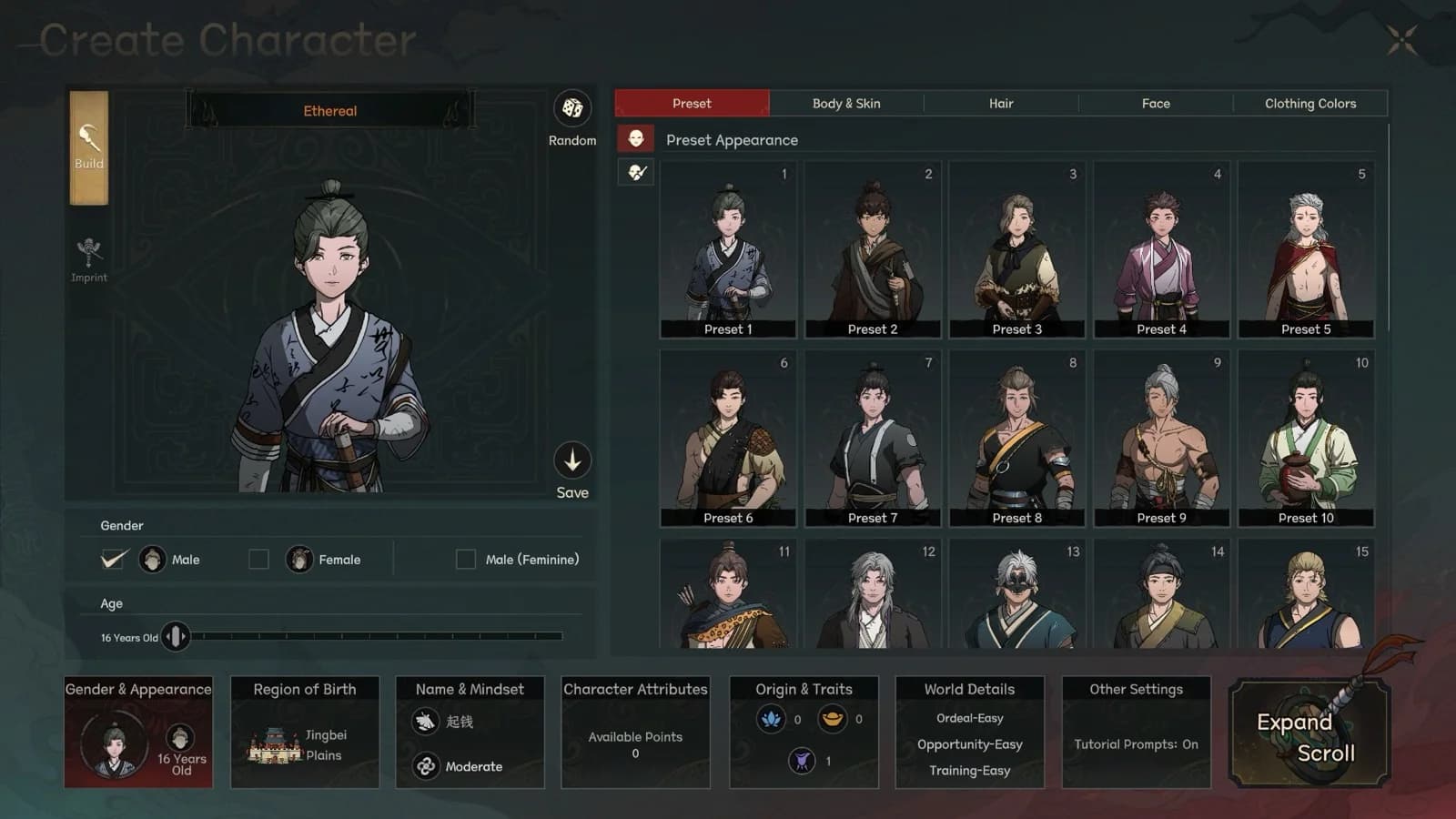
- In World Details during character creation, start on the easier Ordeal / Opportunity / Training presets.
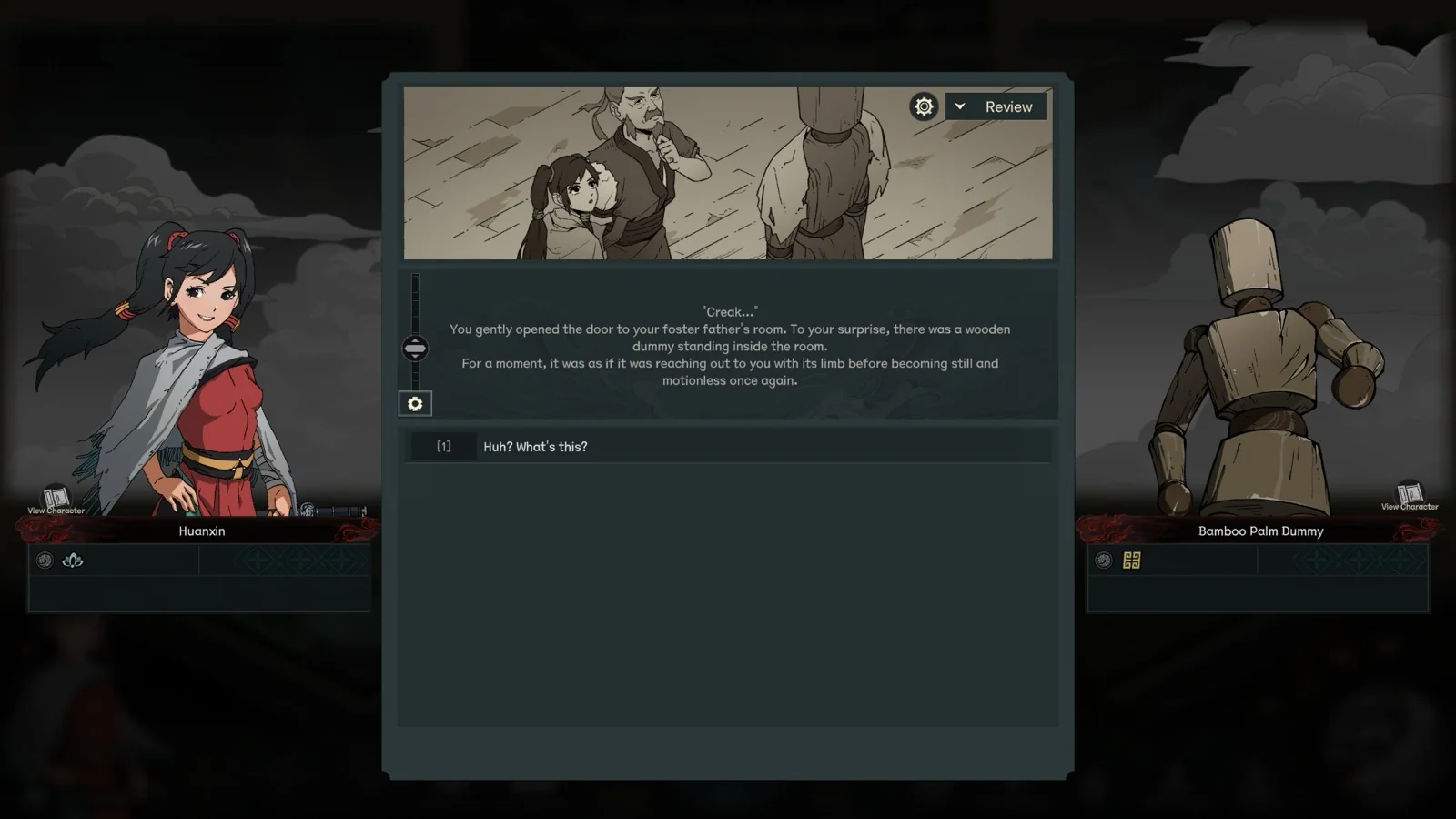
- Text too small? Story dialogue panes have a hidden text-size slider (open the gear on the pane); there is no global font scaling, so use OS display scaling for the rest.
Best first factions
Shaolin is the safest first pick because its defensive tools make combat readable. Wudang is the best second-safe pick if you want swordplay and counters. Emei is a strong third pick for recovery and flexibility. Swordsmith Villa can work if gear progression motivates you, but several early arts gate on Disposition and crafting — prefer Shaolin or Wudang for the smoothest first run.
If none of those themes excite you, use the faction picker to match a safe faction to the playstyle you actually want. The goal of the first faction is not maximum power; it is to keep your decisions understandable while you learn the systems underneath them.
- Safest: Shaolin
- Most balanced: Wudang
- Recovery/support: Emei
- Gear-driven (higher gates): Swordsmith Villa
- Avoid first: Five Immortals, Sanguine Sect, Veil Scar Sect
Your next twenty hours: milestone checklist
Do not try to solve the whole game during the opening. Pick one faction route, read your martial-art effects slowly, keep spare medicine, and avoid fights that look optional and suspiciously dramatic.
Use milestones rather than a rigid hour-by-hour walkthrough. You are ready to widen the campaign when the character can travel, fight, recover, and return home without every trip creating a new crisis.
- Finish the prologue and understand the village, Region map, and World map as three different layers.
- Join or build access to one faction route instead of collecting unrelated manuals.
- Learn one weapon art, one Qi Art, and one Footwork Art that can function together.
- Understand why each art is equipped and which attainment the route is raising.
- Keep your main weapon repaired and upgraded.
- Rest and treat injuries before they become permanent campaign problems.
- Establish a dependable way to earn Silver and village materials.
- Unlock only the travel network needed for your current faction or story goal.
- Complete one meaningful regional objective before chasing every visible marker.
Common beginner mistakes to avoid
Most rough first runs come from a handful of repeated mistakes rather than bad luck. Knowing them in advance lets you sidestep the worst early frustration and keep your character on a stable footing.
If you only remember one thing, remember that overreach is the most common killer. Taking the hard fight, learning the fifth art, or chasing the perfect village before the basics are stable causes more failed runs than any single bad decision.
- Collecting too many martial arts instead of developing a focused few.
- Fighting while injured and turning one bad fight into several.
- Ignoring weapon and gear condition until it costs a fight.
- Restarting too early instead of learning from a messy character.
- Picking a complex heretical faction for a blind first run.
Fast answers for common searches
If you searched for a single early martial art or faction term, start with the matching page and then come back to this beginner route. The safest pattern is still one weapon art, one internal art, and one movement art.
- Long Fist: read Shaolin Long Fist if you want a simple early fist route.
- Lion Roar: treat it as a Lion Face pressure tool, not a universal pickup.
- Changing Tendons, Shrinking Bones (Vajra Sect body art): use it as a defensive internal base with a separate damage plan.
- Wudang clan: choose Wudang if you want balanced swordplay and counter-focused learning.
Related paths
Sources and verification
First-party patch notes and announcements are treated as the source of truth. Community links are included only to show the player question this guide answers.
FAQ
Should I restart if my first character is bad?
Usually no. A messy first character teaches more than a perfect build copied too early.
What should I do after the Scroll of Taiwu prologue?
Stabilize Taiwu Village, choose one faction and combat route, earn teaching access, study and break through a small martial-art loadout, then use nearby encounters and regional stories to test it. Return home to recover and improve, and repeat. There is no single hidden quest that replaces this sandbox loop.
Which faction is easiest?
Shaolin is the safest general recommendation because defense and simple melee routes are easier to understand.
Are the English names final?
Official English is live across the core 1.0 game, while continued localization remains on the development roadmap. This site keeps important Chinese terms beside the English so current UI, older guides, and isolated untranslated strings can still be cross-referenced.
How do I switch the game to English?
The main menu boots Chinese-first, but after the June 17 patch there is a quick language switcher in the top-left corner of the main menu (a globe icon) — click it and choose English. You can also change it under Settings → first tab → language dropdown.
Why does my game say v0.84.75 / 1.0.1 instead of 1.0?
The Default Public Version is the English 1.0 / Complete Edition. The main menu shows 1.0.1 after the day-one patch, and some build strings still read v0.84.75 — both refer to 1.0, not an Early Access leftover. The old EA client is preserved on the separate "test" branch.
Does the game save automatically?
Yes. It auto-saves at the end of each in-game month, so there is no traditional manual quick-save.
The English text is small — can I make it bigger?
There is no global UI font scaling on launch day, but story dialogue panes have a hidden text-size control: open the settings gear on the dialogue pane and a slider appears that scales the text in that pane. It only affects that dialogue pane, not the whole interface — for everything else, use your OS display scaling (on Windows: Settings → Display → Scale).
How long is a Taiwu campaign?
It is a long-form sandbox that can run for many dozens of hours. That length is why a stable, focused first run matters more than an optimized one.