Which Faction Should You Choose?
Compare all 15 Scroll of Taiwu factions by difficulty, weapons, alignment, playstyle, beginner safety, and the first-run questions that matter most.
Choose by comfort, not power
The strongest faction on paper is not the best faction for a new player. Taiwu's systems are dense enough that clarity has real value. A faction that tells you what to do next is often stronger than a faction with advanced tricks.
Your faction choice quietly sets four things at once: the weapons and martial arts you have easy access to, the attributes your route will lean on, the alignment that shapes how the world reacts to you, and the pace at which the game asks you to make hard decisions. A beginner-friendly faction keeps all four of those readable so you can spend your attention on learning combat and the village instead of untangling a fragile identity.
- Pick Shaolin if you want to survive mistakes.
- Pick Wudang if you want balanced swordplay.
- Pick Swordsmith Villa if equipment progression motivates you.
- Pick Valley of Flowers if medicine and long campaigns interest you.
Read a faction by five questions
Instead of comparing all fifteen factions at once, run each candidate through five short questions. The answers tell you far more than a tier ranking, because they describe how the faction will actually feel in your hands during the first ten hours.
If a faction gives you clean answers to all five, it is beginner safe. If two or more answers are vague or demand prior knowledge, treat it as a second-run faction no matter how exciting its theme sounds.
- Range: what distance do its core arts want to fight at?
- Survival: does it forgive a bad trade, or punish it hard?
- Stats: does its route lean on one clear attribute or several at once?
- Resources: does it need rare materials, poison stock, or special upkeep?
- Recovery: how easily can it get back to safe after a fight goes wrong?
The beginner-safe tier
Four factions consistently make the early game readable: Shaolin, Wudang, Swordsmith Villa, and Emei. They differ in flavor but share the same gift for new players, which is that their failure states are easy to understand. When you lose, you can usually name the reason and fix it.
Shaolin leans on Constitution and durable melee, so it absorbs the mistakes every first run makes. Wudang asks for a little more timing but rewards it with sword counters and balanced internal support. Emei offers recovery and flexible range, so injuries become a lesson rather than a spiral. Swordsmith Villa turns crafting and weapon upgrades into visible power — motivating if you want the gear loop, but several early arts gate on Disposition and crafting, so it is a step up in complexity from the three above.
- Shaolin: most forgiving, best pure-survival teacher.
- Wudang: balanced sword route with counters and control.
- Swordsmith Villa: gear-driven progression — higher early Disposition/crafting gates; pick only if forging motivates you.
- Emei: recovery and flexibility for players who want options.
High complexity factions
Five Immortals, Sanguine Sect, Veil Scar Sect, Jade-Maiden Sect, Kongsang, and Ranshan all have excellent identities, but they ask for more knowledge. They are not bad choices; they are expensive choices for your attention.
Each of these factions front-loads a system you have to respect before the faction feels fair. Poison and gu routes want stockpiles and setup. Hidden-weapon routes collapse if your spacing is sloppy. Wound-fed berserker routes need you to ride injury thresholds on purpose, which is the opposite of a safe first run. Pick one of these only when its fantasy is exactly what pulled you to the game, and accept that some early losses are tuition rather than build failures.
- Poison and gu systems need preparation.
- Hidden weapon routes punish poor spacing.
- Berserker routes require injury discipline.
- Hybrid routes are easy to dilute.
Alignment and the social layer
Faction alignment is not just flavor text. Righteous, neutral, and heretical paths change how other characters, sects, and the wider world treat you, which affects trade, recruitment, relationships, and the kinds of trouble that find you. A new player juggling combat and village systems usually wants a social layer that adds context, not extra crisis.
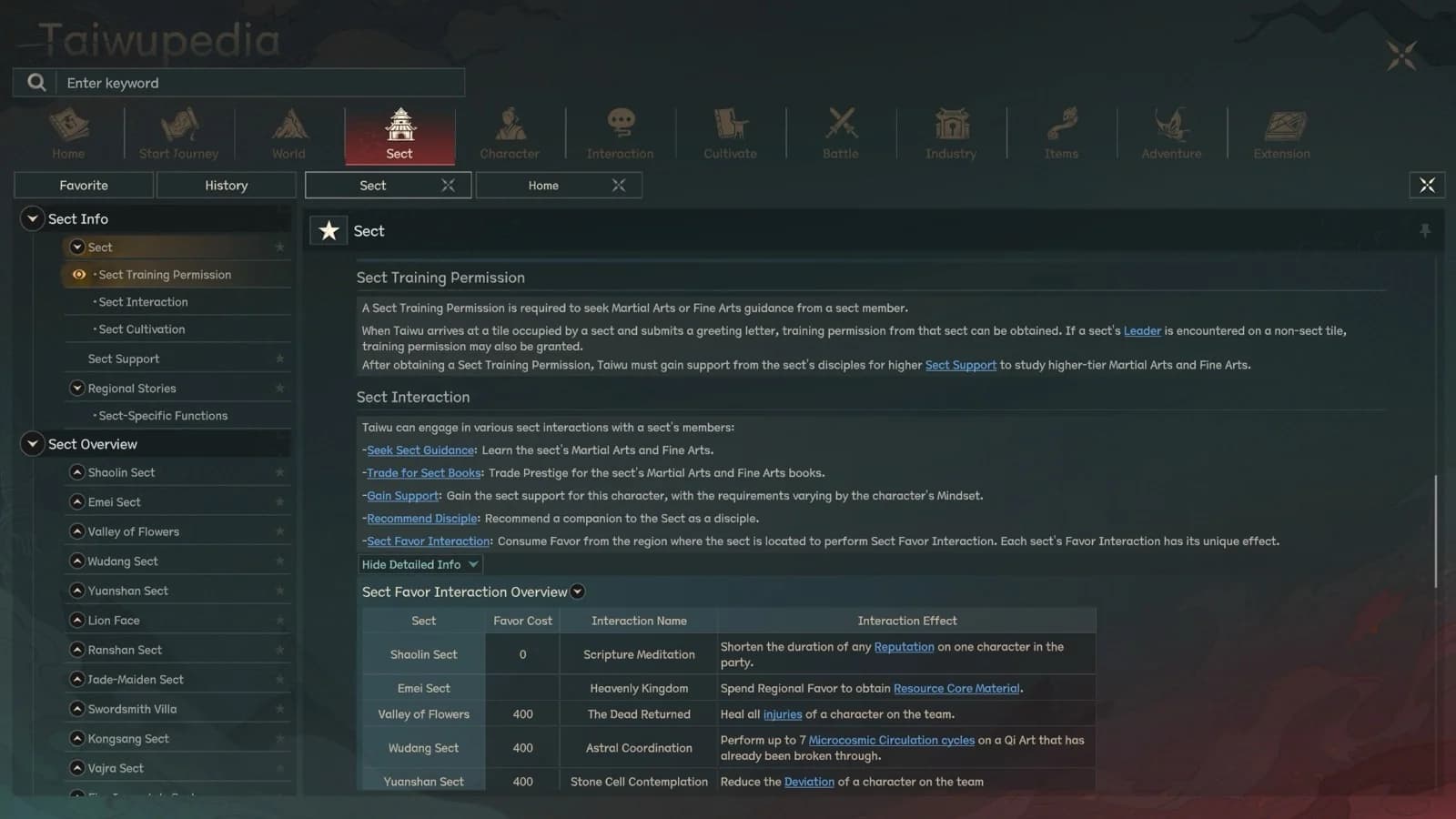
On launch day the live English 1.0 UI makes two of these mechanics explicit. Learning a sect's arts requires a Sect Training Permission, and each region carries its own Favor that powers unique Sect Favor Interactions — so your standing with a faction is a real resource, not just flavor. The sect overview table also labels every faction's Camp as Good, Neutral, or Evil, which is the alignment signal behind the beginner-safe picks above.
This is why heretical factions feel harder even when their combat is strong: you are learning the mechanical systems and managing reputation pressure at the same time. None of that makes heretical wrong. It just means a righteous or neutral first faction lets you learn one hard thing at a time.
- Learning a sect's arts needs that sect's Sect Training Permission first.
- Regional Favor unlocks unique Sect Favor Interactions — treat standing as a resource.
- Camp is labelled Good / Neutral / Evil in the 1.0 sect overview.
- Righteous and neutral starts keep the social layer calmer.
- Heretical starts add reputation pressure on top of combat learning.
- You can always explore heretical paths once the basics are stable.
Related paths
FAQ
Can I learn arts outside my faction?
Yes, but a first build is easier when its core arts share faction logic, attributes, and weapon assumptions. Reaching outside your faction is a great second-run habit, not a great first-run one.
How do I learn another sect's martial arts?
In the 1.0 English UI you need that sect's Sect Training Permission first, and building regional Favor unlocks unique Sect Favor Interactions. Because that standing is a real resource, a beginner-safe faction usually also means an easier social path.
Is heretical always bad?
No. Heretical factions often have stronger identity and sharper mechanics, but they can be harder to manage socially and mechanically, which makes them tougher first teachers.
What is the fastest recommendation tool?
Use the faction picker. It scores factions by your preferred combat style, complexity, and risk tolerance, then points you at a matching starter build.
How locked in is my faction choice?
Your starting faction shapes your easiest path, but Taiwu is a long sandbox. You can branch into other arts and styles over a campaign, so treat the first pick as a teacher rather than a permanent identity.
Should I pick by weapon I like?
That is a reasonable shortcut. If you already know you want sword, staff, fist, or hidden weapon play, start from the safe faction that offers it and you will stay motivated through the learning curve.