Cultivation System Primer
A beginner-safe explanation of martial learning, internal arts, and why spreading too thin slows you down.
Cultivation is commitment
Taiwu rewards focused development. Every new martial art is tempting, but each one asks for practice, attributes, and supporting systems. A small coherent kit beats a museum of half-learned techniques.
Think of cultivation as spending a limited budget of time and attribute fit. A character who pours that budget into three arts that reinforce each other will out-perform a character who owns ten arts at shallow levels. The early game is not a collection challenge; it is a focus challenge, and the players who accept that have a far smoother first campaign.
- Pick a main weapon route.
- Choose one internal art that supports it.
- Add movement only when you know what range problem it solves.
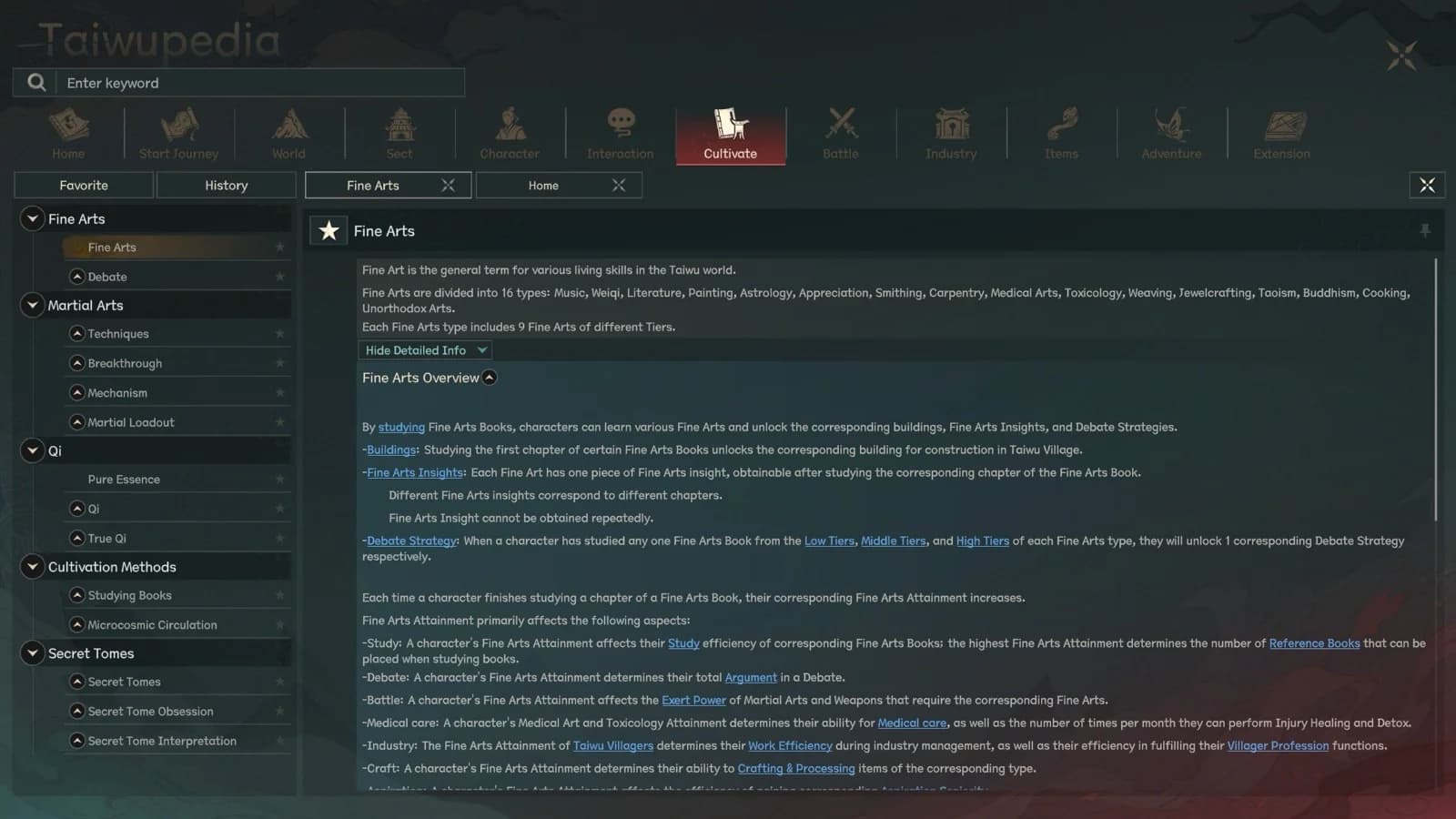
How an art actually becomes strong
A martial art is rarely strong on the day you learn it. It becomes strong as you raise its level, line up the attributes it scales with, and pair it with a weapon and internal base that let it do its job. A high-tier manual learned by the wrong character can feel worse than a humble art used by a character built around it.
This is why comprehension and practice matter as much as the manual itself. Before you chase a famous art, ask whether your character can realistically support the practice cost and the attribute demands. If the answer is no, a simpler art you can fully develop is the better investment right now.
- Manual quality sets the ceiling; your build decides how close you get to it.
- Higher comprehension makes learning and leveling faster.
- An art at full level beats two arts left half-learned.
- Match the art to your weapon and attributes before chasing tier.
Internal arts are the engine
Neigong is easy to underestimate because it is less visually dramatic than a sword technique. In practice, internal arts shape survivability, resource flow, and how reliably your outer arts can work.
If your weapon art is the strike, your internal art is the breathing and posture that lets the strike land without leaving you exposed. Many builds that feel weak are not short on damage; they are short on internal support, so they collapse the moment a fight runs long or an opener fails.
- Defensive builds need stable body and qi support.
- Burst builds need enough internal backing to avoid collapsing after the opener.
- Technical builds need synergy more than raw numbers.
- If your fights feel inconsistent, audit internal support before damage.
A simple first-run cultivation order
When you are unsure where to spend practice, follow a fixed order for the first run. Stabilize the engine, then the pressure, then the positioning, then luxuries. This order keeps you alive while you learn, and it makes every loss easier to diagnose because the foundation is already solid.
Once this core loop feels reliable, you have earned the right to branch. Adding a special or healing art on top of a stable base is satisfying; adding it before the base exists is how first runs unravel.
- Step 1: level one internal art until your survivability feels stable.
- Step 2: bring your main weapon art up to match it.
- Step 3: add a movement art once you know your range problem.
- Step 4: only then consider a special, healing, or utility art.
Related paths
FAQ
How many arts should a beginner level?
Start with three core roles: weapon, internal, and movement. Add more only when you understand the gap they fill.
Can I fix a messy build later?
Usually yes, but it costs time. The earlier you focus, the smoother your campaign feels, because re-leveling neglected arts is slower than developing the right ones from the start.
Should I chase the rarest (Tier 1-2) arts?
Not before you understand whether your character can actually support them. A rare low-tier-number art on an unsuited character often underperforms a well-supported, accessible higher-tier-number art that you have actually practiced.
Does comprehension really matter that much?
Yes. Higher comprehension speeds up learning and leveling, which compounds over a long campaign. Low-comprehension characters should keep their kit simple and well-focused.