How Combat Works
A beginner-friendly explanation of Scroll of Taiwu combat: range, rhythm, martial art roles, defenses, injuries, and why early fights feel confusing.
The short answer
Combat in The Scroll of Taiwu is easiest to understand as a range and rhythm problem. A good build is not only a strong martial art. It is a plan for standing at the right distance, using the right weapon or art, keeping internal support stable, and leaving the fight before injuries become a campaign problem.
If you are losing early fights, do not only ask which art has the highest damage. Ask whether your weapon range, movement art, internal art, defenses, and recovery plan all point in the same direction.
- Range decides whether your main art can actually function.
- Internal arts keep the body, qi, and defenses from collapsing.
- Movement arts are not optional speed flavor; they solve positioning problems.
- Injuries are feedback about bad trades, not only a healing chore.
Start with range
Many new players read combat as a damage race, but Taiwu often punishes you before damage numbers matter. Staff, sword, fist, needle, blade, and hidden weapon plans all want different distances and tempo. Standing in the wrong place can make a good art look weak.
A beginner route should answer one question before anything else: where does this build want to fight? Shaolin staff wants stable reach and readable defense. Wudang sword wants balanced control and timing. Needle and hidden weapon routes often ask for cleaner spacing and more patience.
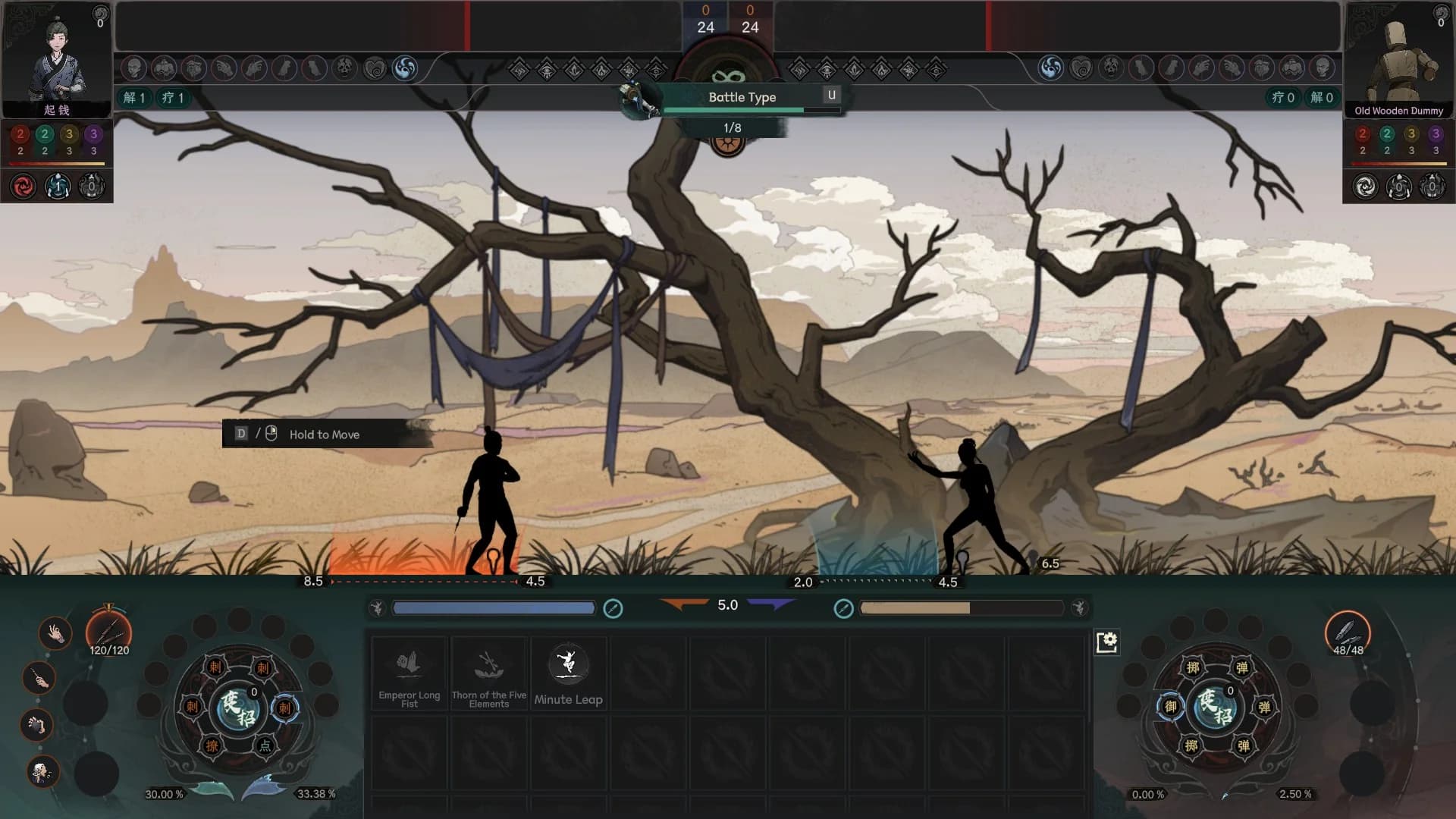
The combat field is a 2D side-scroll arena. Your character and the enemy each have a position on a distance line. The heatmap at the bottom of the screen shows your arts' effective attack ranges — matching that window to where you stand is half the battle.
- If the enemy keeps forcing you close, check movement support.
- If your attacks feel inconsistent, check whether your weapon range matches the exchange.
- If fragile routes collapse quickly, simplify before adding advanced tricks.
- If you do not know the range plan, pick a safer faction first.
Every art needs a job
A stable first build usually needs one pressure art, one internal support art, and one movement answer. Extra utility can help, but collecting unrelated arts makes the character harder to read. If two arts ask for different stats, ranges, or combat rhythms, the build may feel weaker than either art deserves.
This is why beginner builds on this site are organized around coherence rather than theoretical endgame power. The first goal is to make each fight explainable.
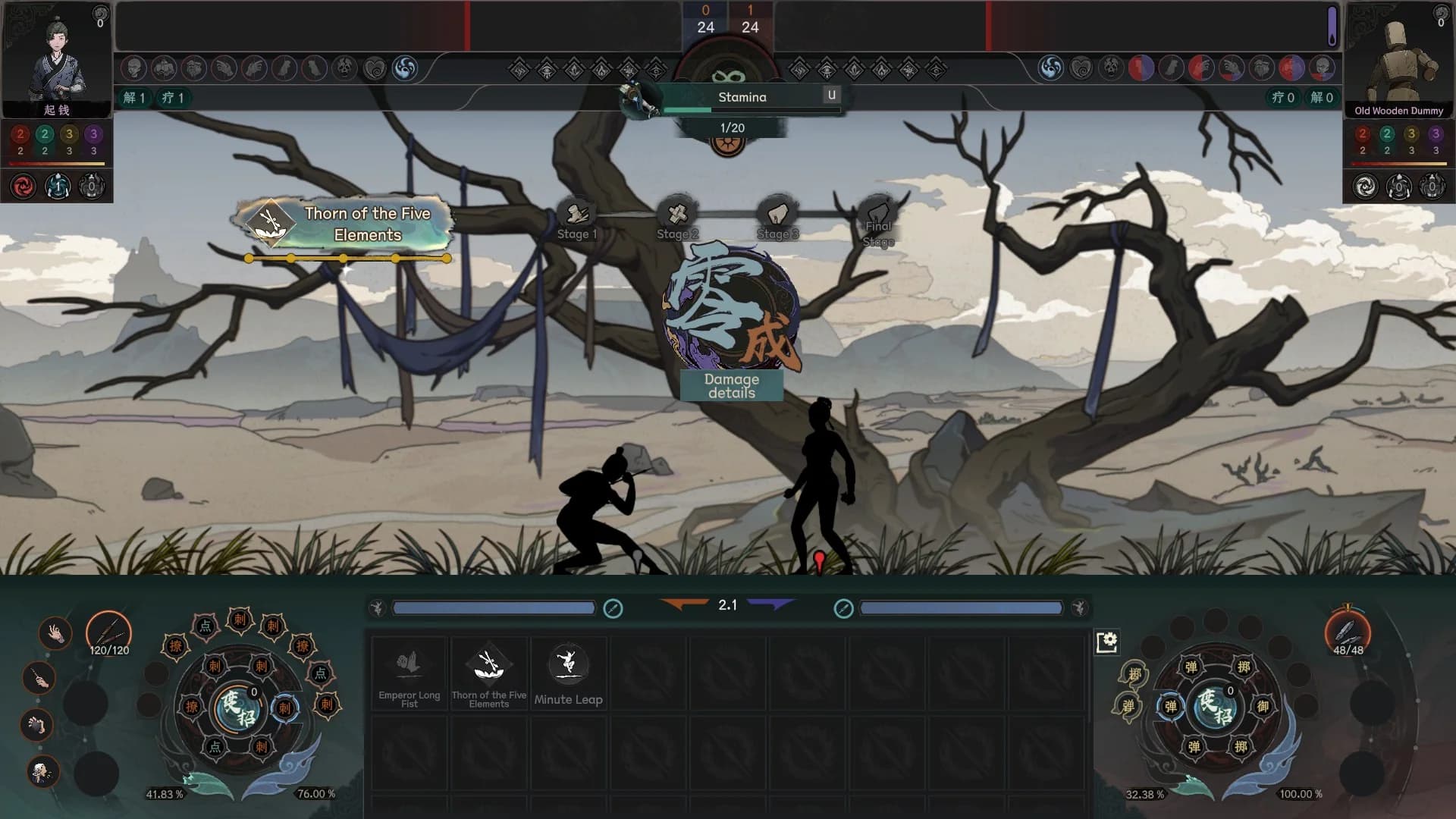
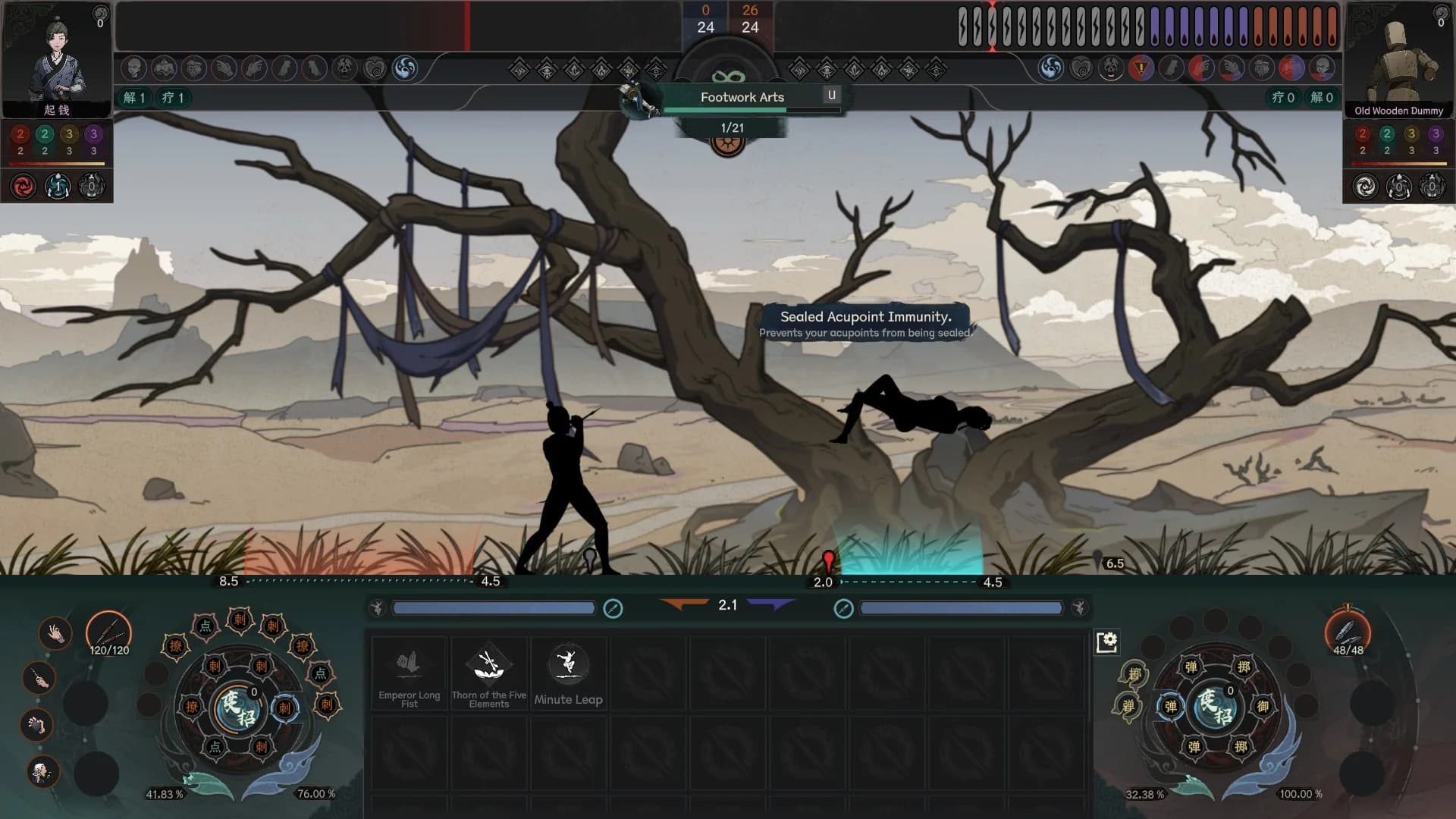
Each martial art has Stages that chain into each other during combat. When a move lands, the next stage in the combo becomes available. The Stamina bar at the top of the combat screen tracks how long the fight has gone — depleting Stamina accelerates fatigue pressure on both sides.
- Pressure art: how you threaten or win exchanges.
- Internal art: how your body and qi support the plan.
- Movement art: how you enter, hold, or escape the right range.
- Recovery tool: how you prevent mistakes from damaging the whole campaign.
Read injuries as combat feedback
When a fight leaves you injured, healing is only half the lesson. The more useful question is what caused the injury. Did you trade at the wrong range? Did you ignore internal defense? Did you chain fights while already hurt? Did the enemy punish a weapon mismatch?
This mindset matters because Taiwu is a long campaign game. A bad fight can make travel, village planning, medicine, and the next fight worse. Prevention is often stronger than repair for a first run.
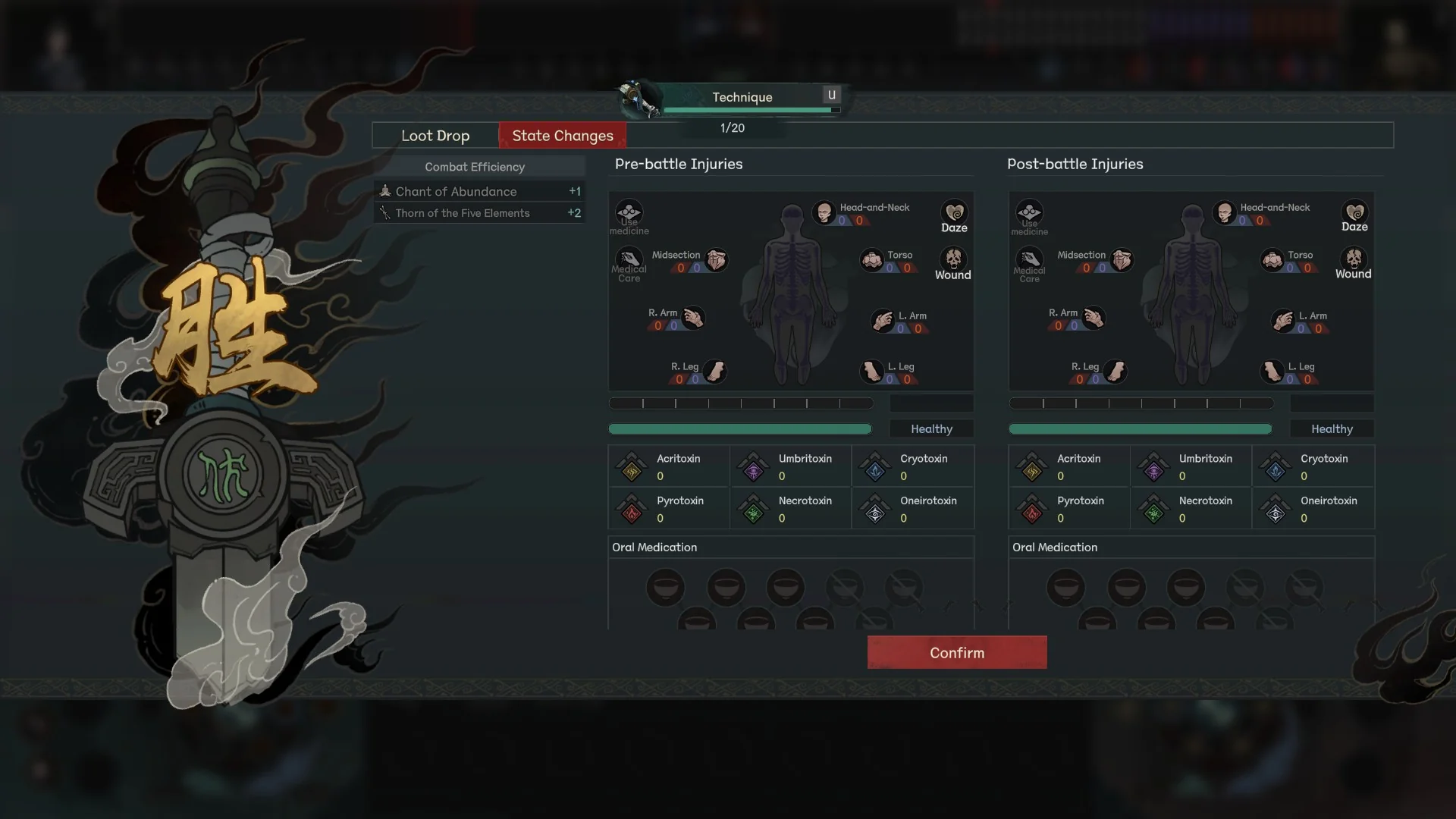
After every fight the State Changes screen shows your Pre-battle vs Post-battle injury comparison side by side, and lists your Combat Efficiency gains per art. Use this screen to see exactly which body parts took damage and how much each martial art grew from the encounter.
- Repeated external injuries may point to bad trades or poor armor.
- Repeated internal pressure may point to weak internal support.
- Poison pressure usually asks for preparation, not bravery.
- If every fight feels random, return to the first 10 hours checklist.
- State Changes screen after battle: Pre/Post injury comparison + Combat Efficiency per art.
Related paths
FAQ
Why do I lose even with a high-tier martial art?
A high-tier art still needs matching range, stats, weapon support, internal backing, and enough practice. One strong art is not a full combat plan.
Should beginners focus on damage or defense?
Beginners should value readable defense and stable range first. Damage becomes more useful once you can understand why an exchange went wrong.
Are the English combat terms final?
Combat terms are shown with their Chinese characters so you can match each one to the in-game UI and to Chinese strategy guides.